
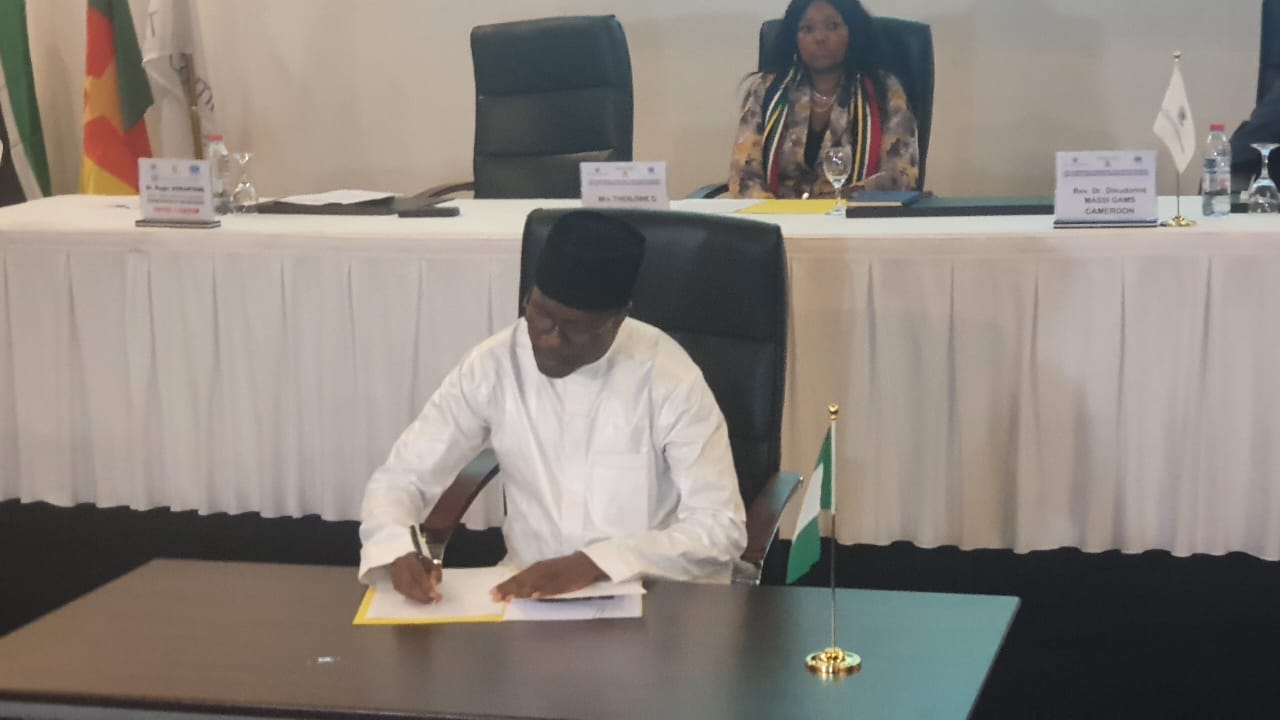
The Chairman of the Independent Corrupt Practices and Other Related Offences Commission (ICPC), Dr. Musa Adamu Aliyu, has showcased Nigeria’s technology-driven anti-corruption initiative, the Constituency and Executive Projects Tracking Initiative (CEPTI), at the 16th Regional Conference and Annual General Meeting of Heads of Anti-Corruption Agencies in Commonwealth Africa held in Yaoundé.
The conference, hosted by the National Anti-Corruption Commission of Cameroon in collaboration with the Commonwealth Secretariat, was themed: “Deploying Artificial Intelligence in the Fight Against Corruption in Commonwealth Africa.”
Presenting Nigeria’s country paper, Mr. Ahmed Abdul, ICPC’s Head of External Cooperation, who did so on behalf of the ICPC Chairman, described CEPTI as a proactive technology-based mechanism designed to ensure transparency, accountability, and value for money in the execution of government-funded projects across Nigeria.
According to him, the initiatives that are supported with geospatial mapping technology enable the Commission to carry out real-time monitoring, validation, and analysis of constituency and executive projects nationwide.
He disclosed that projects worth over N22.9 trillion have been tracked under CEPTI since inception, while cash recoveries on improperly executed projects exceed N4.9 billion, with savings to the Federal Government from aborted, inflated, or re-scoped projects standing at over N91.4 billion.
The ICPC Chairman further explained that the initiative has significantly reduced corrupt practices associated with public infrastructure delivery, including contract inflation, diversion of funds, ghost projects, and project abandonment, while compelling contractors to return to abandoned sites for completion.
Dr. Aliyu stressed that Artificial Intelligence, data analytics, and geospatial technology have become critical tools in strengthening transparency and accountability in governance, urging anti-corruption agencies across Commonwealth Africa to institutionalise technology-driven project-tracking frameworks and deepen collaboration in digital investigation and data science.
At the end of the conference, Heads of Anti-Corruption Agencies across Commonwealth Africa adopted far-reaching resolutions aimed at strengthening the fight against corruption through the deployment of Artificial Intelligence.
In a communiqué issued after the conference, delegates resolved to promote digital transformation in public service delivery, encourage the adoption of strategic digital technologies to improve transparency in public procurement and public finance management, and strengthen policy frameworks for the recovery of stolen assets.
The agencies also agreed to deepen collaboration and build the capacities of anti-corruption personnel in the use of Artificial Intelligence for evidence gathering, investigation, and prosecution of corruption cases, while empowering young people with digital skills to promote integrity and accountability across the continent.
The communiqué further confirmed that the National Anti-Corruption Commission of Cameroon will assume the Chair of the Association of Anti-Corruption Agencies in Commonwealth Africa for the 2026–2027 period, while Kenya will host the 17th Regional Conference and Annual General Meeting in 2027.