
In the ongoing battle against corruption, considerable emphasis has been placed on punitive measures, such as handcuffs to apprehend wrongdoers, courtrooms where justice is sought, and prison sentences intended to penalise corruption. However, it is equally essential to recognise and reward acts of integrity, as these are fundamental to cultivating a culture of honesty and accountability. In Nigeria, the Independent Corrupt Practices and Other Related Offences Commission (ICPC) plays a pivotal role in this initiative through its prestigious Public Service Integrity Award.
Established to honour and celebrate public servants who exemplify exceptional integrity in their roles, this annual award serves to actively promote ethical behaviour across the public sector. By shining a spotlight on those who demonstrate unwavering commitment to ethical standards, the award seeks not only to recognise individual achievements but also to inspire others within the civil service to aspire to similar ideals.
Nominations for the Public Service Integrity Award are solicited from a wide spectrum of Ministries, Departments, and Agencies (MDAs), ensuring a diverse pool of candidates. Once nominations are submitted, a dedicated committee within the ICPC meticulously evaluates each nominee. This evaluation focuses on their demonstrated contributions to integrity and anti-corruption efforts, considering factors such as their ethical decision-making, transparency in dealings, and ability to influence a culture of integrity within their respective organisations.
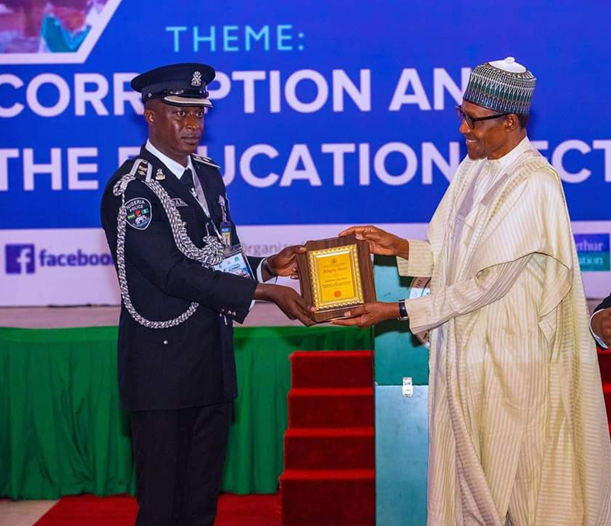
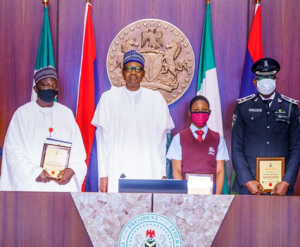
SP Daniel Itse Amah, receiving his award from President Muhammadu Buhari, on 4th October 2022
The impact of the Public Service Integrity Award is profound and multifaceted. By publicly acknowledging and rewarding ethical behaviour, the award not only motivates public servants to adopt and maintain high standards of integrity but also reinforces the expectation that integrity is a fundamental component of public service. This initiative helps establish it as a core value within governmental institutions, ultimately contributing to the creation of a system where ethical practices are regarded as the norm rather than the exception.
Furthermore, by highlighting and celebrating exemplary behaviour among public servants, the ICPC fosters a culture of accountability that is crucial for good governance. As public institutions increasingly embrace integrity as a staple of their operational framework, the overall health and functionality of these institutions are enhanced, paving the way for improved trust and confidence from the public they serve. In this way, the Public Service Integrity Award not only honours individual achievement but also plays a significant role in the broader fight against corruption in Nigeria.
Why Recognition is Important in the Fight Against Corruption
Corruption often flourishes when unethical behaviour is left unchecked. In contrast, integrity thrives in environments filled with transparency and honesty. The Independent Corrupt Practices and Other Related Offences Commission (ICPC) understands that shining a light on public servants who actively confront corruption sends a strong message throughout the country.
Integrity is much more than just a value; it represents true heroism. Choosing to act honestly over succumbing to personal gain takes real courage. Public servants who maintain ethical standards are not only protecting society but also inspiring others to do the same. Recognising their integrity highlights the significance of moral courage and helps transform individual actions into a united front against corruption.
The ripple effect of integrity is also remarkable. The determination of one person can spark inspiration in others, encouraging them to embrace the same steadfast values. When ethical behaviour is publicly acknowledged, it creates an atmosphere where honesty is celebrated, leading to a sense of pride and admiration within the community.
The positive impacts of integrity go beyond simply earning respect; they help cultivate a societal norm that prioritises honesty. When we recognise acts of integrity, they serve as a source of motivation for everyone around us. This sends a crucial message: every commitment to integrity counts, and every act of integrity does not go unnoticed.
By celebrating acts of integrity, we encourage individuals to strive for ethical behaviour and affirm that integrity is not just a personal virtue but a powerful catalyst for positive change in society.
Stories That Inspire a Nation
Mrs Josephine Ugwu: A Beacon of Integrity in Public Service
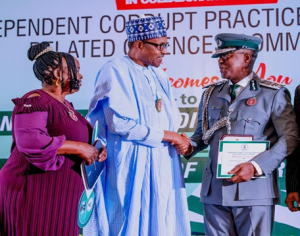
Mrs Josephine Ugwu (L) and ACG Bashir Abubakar (R) receiving their awards from President Muhammadu Buhari, in 2019
In the bustling environment of Murtala Muhammed International Airport in 2014, Josephine Ugwu, a diligent cleaner, stumbled upon an astonishing find: N8 million. Faced with the choice of keeping the money for herself or returning it, she chose the path of integrity, displaying a level of character that is all too rare. This decision was not an isolated incident; she later returned additional sums of $12,000 and N200,000, each time prioritising honesty over the temptation of financial gain. Her modest salary as a cleaner stood in stark contrast to the priceless value of her ethical conviction. In 2019, her exceptional commitment to integrity was recognised by the ICPC with the prestigious Public Service Integrity Award, along with a new home and a cash prize. Today, Josephine Ugwu’s name is spoken with admiration and respect, serving as a powerful reminder that true greatness is defined not by one’s title but by one’s actions and character.
ACG Bashir Abubakar: A Guardian of Ethics in Customs Service
In a high-stakes scenario, Assistant Comptroller-General Bashir Abubakar encountered a perilous offer from traffickers who proposed a staggering $412,000 in exchange for releasing 40 containers laden with the potent drug Tramadol. With the weight of public safety on his shoulders, Abubakar made a resolute choice to refuse the bribe, putting the welfare of millions above the allure of wealth. His courageous stand not only thwarted the distribution of a dangerous substance, but it also served as a striking example of how integrity can triumph even in the face of overwhelming temptation. His story echoes the sentiment that a single honest decision can yield profound benefits for countless lives. Today, post-retirement from the Customs Service, he is the country’s Chief Ombudsman as Chief Commissioner of the Public Complaints Commission.
Assistant Commander Muhammad Tukur Ahmad: A Stalwart against Corruption
In 2021, Assistant Commander Muhammad Tukur Ahmad of the National Drug Law Enforcement Agency (NDLEA) faced a morally challenging proposition when a drug baron offered him a bribe of $24,500. Choosing to reject this offer, Ahmad demonstrated an unwavering commitment to his duty, ultimately leading to the seizure of nearly 28 kilograms of cocaine. His firm stance was not merely about declining a financial incentive; it represented a bold commitment to protect the future of his community from the toxic grip of drugs. Ahmad’s actions illuminate the critical role that integrity plays in maintaining the moral fabric of society and combating the scourge of corruption.
Nelson Orji Okoronkwo: Champion of Accountability and Integrity
In the realm of agricultural governance, Deputy Director Nelson Orji Okoronkwo emerged as a formidable force against corruption. His tireless efforts in the fertiliser distribution sector resulted in the recovery of billions of naira that had been appropriated, ensuring that funds meant for farmers were returned to the rightful purpose. Okoronkwo’s dedication to accountability not only revitalised trust in the agricultural sector but also reinforced the notion that integrity serves as the backbone of sustainable development. His work exemplifies how principled leadership can transform public trust and enhance collective welfare.
Mallam Hamza Adamu Buwai: The Guardian of Financial Integrity
(L-R) Mallam Hamza Adamu Buwai, President Muhammadu Buhari, Chiekezi Favour (1st position winner JSS Essay Competition) & ACP Francis Osagie Erhabor
In 2004, amidst an atmosphere of financial uncertainty, Mallam Hamza Adamu Buwai emerged as a vigilant protector of public resources. He played a pivotal role in preventing the loss of a staggering N2.5 billion that was at risk due to a distressed bank. His astute awareness of financial matters continued to shine in 2015 when he identified a significant N7.9 billion liability entry that had been erroneously recorded. Buwai’s proactive measures and thorough oversight not only safeguarded public funds but also illustrated the critical importance of integrity in financial governance. His legacy serves as a testament to the idea that unwavering integrity can lead to better resource management and a stronger institutional framework.
The Ripple Effect of Integrity
The influence of remarkable individuals extends far beyond their personal actions; they become powerful catalysts for change that ripple across society in profound ways. Consider the following scenarios that illustrate this transformative impact:
- Imagine a dedicated employee who bravely refuses a tempting bribe. In that moment, a spark ignites among fellow employees. They witness firsthand that it is indeed possible to uphold integrity under pressure. This courageous act encourages others to follow suit, creating a formidable culture of honesty within the organisation.
- Picture a humble cleaner who discovers a bag filled with millions and chooses to return it to its rightful owner. This act of selflessness resonates deeply within the community, instilling a renewed sense of hope among ordinary Nigerians. It opens their eyes to the possibility that integrity and honesty can coexist within their society, encouraging them to embrace these values in their own lives.
- In a school setting, when educators share tales of exemplary individuals who demonstrate unwavering integrity, they plant the seeds of moral understanding in the hearts and minds of young students. These stories transform into valuable lessons, teaching children that integrity is not just a moral choice but a pathway to earning respect and honour within their communities.
As stories of integrity gain recognition and are celebrated, they foster a contagious spirit of ethical behaviour. This positive momentum gradually spreads through various sectors and institutions, from bustling airports to government ministries, customs offices, and vibrant classrooms. Integrity becomes a collective endeavour, uniting individuals and inspiring them to contribute to a culture of honesty and respect in all aspects of life.
Beyond Awards: Building Systems of Integrity in Nigeria
In a country rich with potential and resilience like Nigeria, the recognition of individuals who exemplify integrity through awards is undoubtedly significant. These moments of celebration inspire hope and remind us of the values we aspire to uphold. However, while honouring personal achievements is crucial, we must also focus on creating sturdy systems that encourage ethical behaviour and effectively combat corruption. This approach requires more than just acknowledgement; it calls for a collective commitment to building a society that thrives on trust and accountability.
At the heart of this transformation is the need for transparent decision-making processes within the government. When decisions are made openly and based on clear criteria, it empowers citizens to hold their leaders accountable. This transparency is a vital ingredient in building trust; it reassures the public that their representatives are truly working for them. Imagine a government where people feel confident participating in civic life, knowing their voices matter and that their concerns will be addressed fairly.
Implementing strong anti-corruption policies is another crucial step toward fostering integrity. Creating comprehensive measures is just the beginning—these policies need to be consistently enforced. It’s not enough to draft laws; they must be actively applied to deter wrongdoing and nurture an environment where fairness reigns. When people see that accountability is not just a buzzword but a reality, it encourages a sense of belonging and pride in the system.
Community engagement plays an equally vital role in building a culture of integrity. Establishing local integrity clubs and hosting workshops can bring citizens together at the grassroots level, sparking conversations about ethical standards and accountability. When communities unite to discuss integrity, they empower individuals to take ownership of their actions and hold each other accountable. This grassroots effort fosters a shared commitment to doing what’s right, reminding everyone that integrity begins at home.
Training for public servants cannot be underestimated either. Equipping officials with the necessary skills and knowledge to recognise and resist corrupt opportunities is essential for creating a trustworthy system. When public servants understand the weight of their influence, they become champions of integrity. Targeted training reinforces their commitment to uphold ethical standards and recognise that their work impacts countless lives.
At the forefront of the desired transformation in Nigeria is the ICPC. For instance, the Commission has established over 500 Students Anti-Corruption Clubs (SAC) and Students Anti-Corruption Vanguard (SAV) in secondary and tertiary institutions across the country. It has conducted hundreds of Training sessions for public servants, including political office holders, on transparency and accountability at the Anti-Corruption Academy of Nigeria (ACAN) – the training arm of the ICPC. Similarly, the Commission regularly conducts Corruption Risks Assessment (CRA) of all the Ministries, Departments and Agencies of government, and organises workshops, including citizens and grassroots mobilisation engagements on attitude change.
A Call to Every Nigerian
The Public Service Integrity Award is not merely a recognition for specific roles such as cleaners, customs officials, or high-ranking directors; it is a celebration of the integrity embodied by every Nigerian citizen. This award emphasises that integrity is not a solitary virtue found in a select few; instead, it is a collective responsibility that resonates throughout our entire nation.
Every day, countless individuals are faced with choices that test their moral fibre. When you, as an individual, refuse a bribe, you are standing up against corruption. When you find and return lost money or valuable items, you are promoting a culture of honesty and accountability. When you choose to speak the truth, even when it might be uncomfortable or risky, you are demonstrating courage and setting an example for others to follow.
In each of these instances, you are not just acting in your own interest; you are contributing to a larger movement that upholds the values of honesty and integrity. By making these choices, you align yourself with the ranks of heroes within our society who aspire to foster an environment where ethical behaviour is the norm rather than the exception.
As we strive for a better future, let us remember that integrity is the foundational principle upon which a prosperous nation is built. It is a calling that extends to all Nigerians, urging us to uphold our shared values and ideals. Together, we can create a culture that celebrates and rewards integrity in every facet of public life.
Conclusion: Towards a Corruption-Free Nigeria
Nigeria’s path to a brighter future involves more than just punitive measures; it also requires recognising and honouring individuals who exemplify integrity. The Public Service Integrity Award serves as both a recognition of excellence and a movement advocating for the idea that honesty is both attainable and deserving of celebration.
Prominent figures such as Josephine Ugwu, Bashir Abubakar, Muhammad Tukur Ahmad, Nelson Orji Okoronkwo, and Hamza Adamu Buwai demonstrate that integrity is not a mere concept but a tangible force that can save substantial financial resources, safeguard lives, restore public trust, and inspire future generations.
By recognising these individuals, we symbolically ignite a beacon of hope for the nation, sending a clear message that a corruption-free Nigeria is achievable and that justice and greatness are within reach.
The campaign against corruption encompasses more than the punishment of wrongdoers; it also includes the celebration of honest individuals. The objective is to cultivate a society where integrity is valued, rewarded, and remembered.
Therefore, it is essential to honour those who exemplify these principles, share their stories, and emulate their actions. The courage displayed by these integrity champions represents a significant hope for a Nigeria free from corruption.