
A forensic accountability framework aimed at detecting and addressing financial irregularities within local government systems has been launched in Ondo State, with the Independent Corrupt Practices and Other Related Offences Commission (ICPC) pledging sustained oversight, rigorous enforcement, and measurable institutional reforms.
The Transparency and Accountability Initiative (TAI), developed by the Ondo State Public Complaints, Financial Crimes and Anti-Corruption Commission (SPFACC) in partnership with the ICPC, was formally unveiled recently.
The event, held at the Cocoa Conference Hall of the Governor’s Office in Alagbaka, Akure, brought together local government chairmen, permanent secretaries, and other key stakeholders.
Declaring the initiative open on behalf of the state governor, Lucky Orimisan Aiyedatiwa, the Attorney-General and Commissioner for Justice, Mr Kayode Ajulo, SAN, described the forensic component as a pragmatic governance tool designed to enhance transparency and restore public confidence in the management of public finances.
“This initiative is not an abstract policy construct. It is a practical instrument rooted in forensic accounting and auditing methodologies, intended to illuminate processes, detect irregularities, and provide empirical clarity in the handling of public funds,” Mr Ajulo said.
He stressed that stronger accountability at the local government level would translate directly into improved service delivery across critical sectors, including primary healthcare, education, and community development.
Speaking as the special guest of honour, the Resident Anti-Corruption Commissioner for Ondo and Ekiti States, Mr Tiku Andrew Menge, framed the initiative as a system-driven intervention that shifts accountability from discretionary practice to verifiable process.
“Transparency in governance is not sustained by intention alone. It is sustained by systems that can withstand scrutiny,” Mr Menge asserted.
He explained that the forensic framework operates by systematically examining financial records, tracing the movement of public funds, and generating evidence capable of supporting administrative sanctions or legal action where necessary. Mr Menge assured stakeholders that the ICPC would provide continued technical collaboration, implementation monitoring, and enforcement support to ensure that outcomes from the exercise are fully acted upon.
Earlier in his welcome address, the Chairman of SPFACC, retired Justice Williams Akintoroye, underscored the importance of embedding accountability at the grassroots level, noting that effective local governance must be responsive to citizens’ needs through transparent systems.
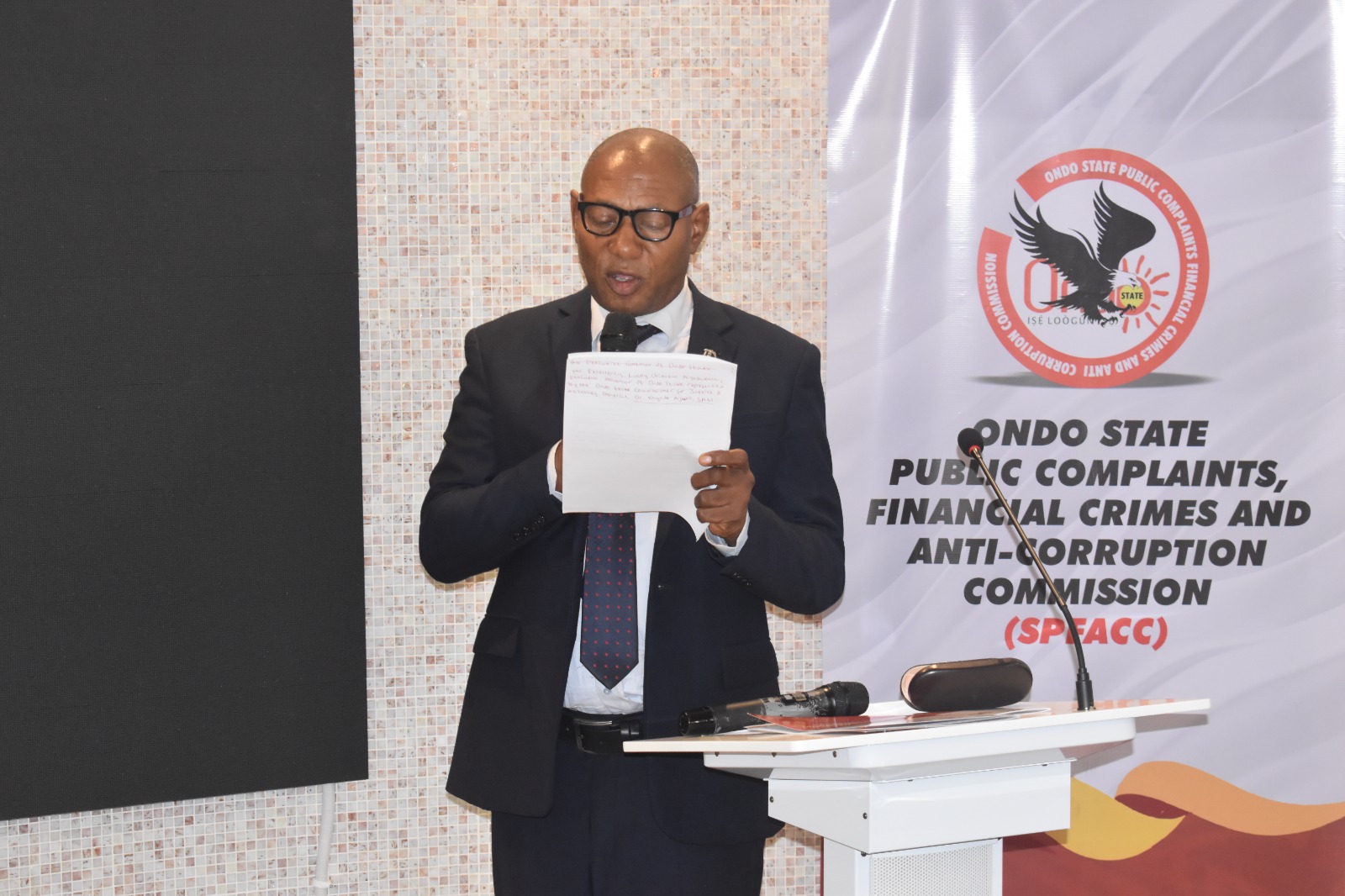
A central feature of the programme was the technical presentation of the forensic framework by the Secretary to the Commission, Professor Adeyeye Adewole. He outlined the initiative as a structured methodology for strengthening financial oversight across local governments, integrating detailed record examination, analytical review, and investigative procedures to identify irregularities, assign responsibility, and ensure corrective actions are enforced within established administrative and legal processes.
Welcoming participants, the Honourable Commissioner for Local Government and Chieftaincy Affairs, Mr Amidu Takuro, described the initiative as a strategic reform designed to institutionalise transparency and accountability in local government administration.
“This initiative marks the beginning of a structured process to instil a culture of transparency, accountability, and effective service delivery at the grassroots,” Mr Takuro noted.
He added that Ondo State is among the first in the country to implement the initiative, reflecting the government’s commitment to 6 stakeholders for their participation.