

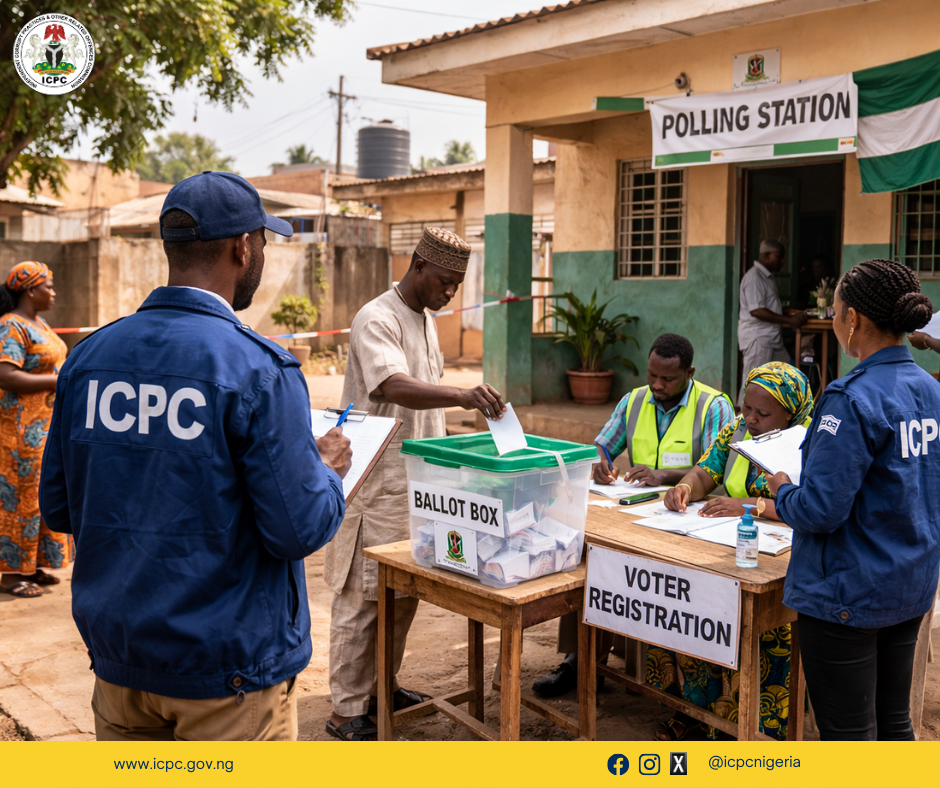
The Independent Corrupt Practices and Other Related Offences Commission (ICPC) on Saturday deployed its operatives across the six Area Councils of the Federal Capital Territory (FCT) to monitor the conduct of the Chairmanship and Councillorship elections. The strategic deployment was part of the Commission’s ongoing efforts to curb vote-buying, voter inducement, and other forms of electoral malpractice.
The monitoring exercise recorded a notable incident in the Abaji Area Council, where ICPC election monitors intercepted individuals allegedly compiling voters’ telephone numbers and other personal details in the vicinity of polling units. The Commission, acting within its statutory mandate to prevent and prosecute corruption and related offences, has increasingly assumed a proactive role in safeguarding the integrity of electoral processes.
Prior to the elections, the ICPC had issued a clear warning that its operatives would be fully deployed to ensure strict compliance with electoral laws and to promote a corruption-free poll. Experience has shown that the visible presence of anti-corruption personnel at polling units serves as a strong deterrent to vote-buying and other forms of electoral misconduct.
In Abaji, ICPC officials observed persons discreetly recording voters’ contact information as they approached polling booths. Acting swiftly, the monitoring team confronted the individuals and confiscated documents containing the suspected illegally obtained data. Although the incident generated brief tension among some party supporters in the area, no arrests were made at the scene.
Electoral observers have consistently noted that the collection of voters’ telephone numbers during elections is often a precursor to vote-buying schemes. Such information can be used to contact voters immediately after they have cast their ballots in order to facilitate financial inducements. By seizing the materials, the Commission effectively disrupted any potential attempt to manipulate the voting process through monetary incentives.
The ICPC has reiterated that its election monitoring activities extend beyond vote-buying to include oversight of the conduct of public officials and electoral personnel. In previous electoral exercises, the Commission established rapid response channels to receive and act upon complaints from members of the public. While the situation in Abaji was resolved without immediate arrests, the incident underscores the Commission’s vigilance and unwavering commitment to protecting the sanctity of the ballot.
As collation of results commences across the six Area Councils — Abaji, Kuje, Bwari, Kwali, Gwagwalada, and the Abuja Municipal Area Council (AMAC) ; the ICPC assures residents that all field reports will be thoroughly reviewed. The seized materials from Abaji will be subjected to further scrutiny as part of a broader investigation into possible electoral offences.
The Commission remains resolute in its commitment to supporting free, fair, and credible elections. It urges members of the public to report any suspicious activities through its established reporting channels.