
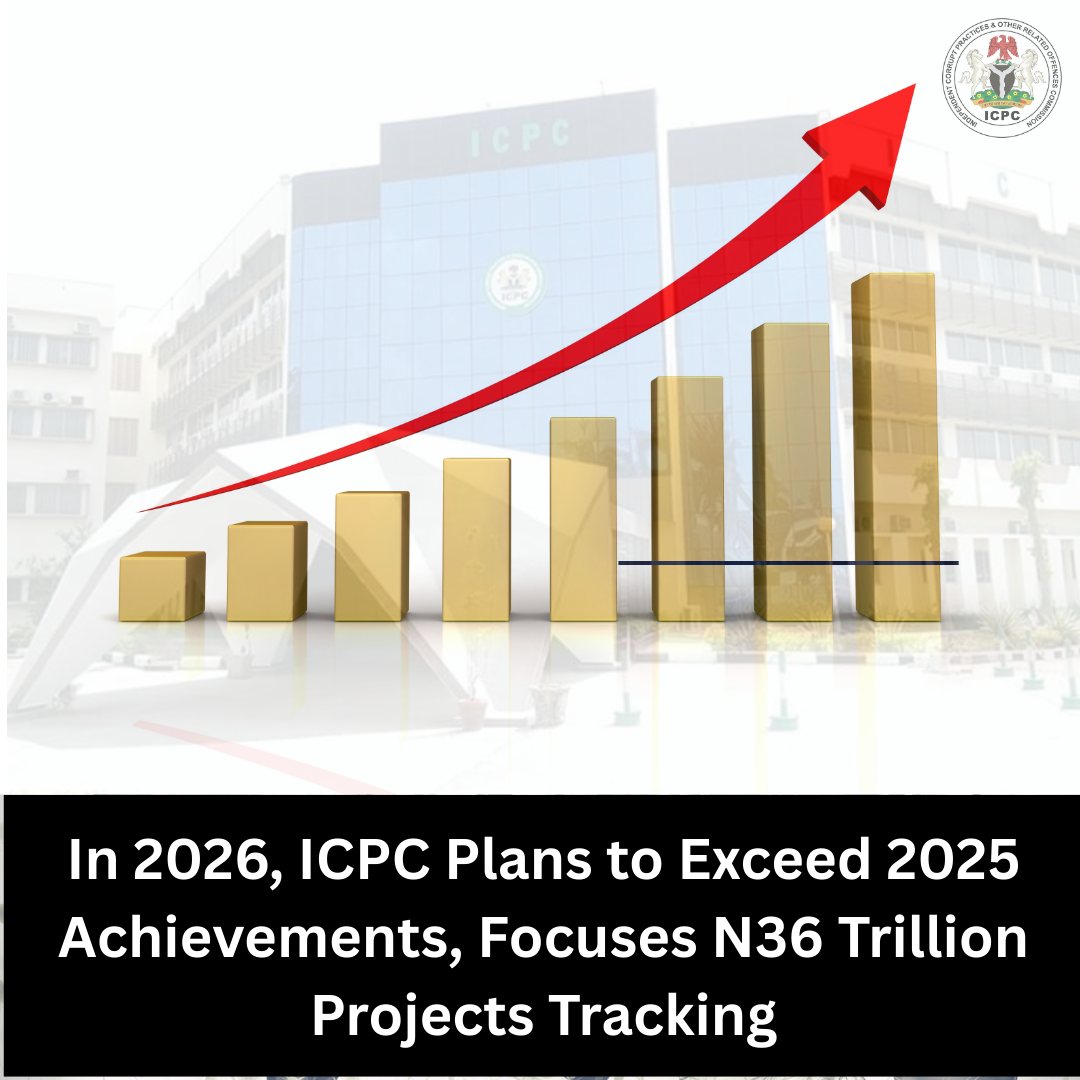
By any objective measure, 2025 was a watershed year for Nigeria’s anti-corruption fight. The Independent Corrupt Practices and Other Related Offences Commission (ICPC) closed the period with a formidable record: the recovery of ₦37.44 billion and $2.35 million through asset seizures and forfeitures—one of the highest annual recovery figures in its history. Yet, as the Commission turns the page to 2026, its leadership has declared that consolidation is not enough. The mandate is clear: build on this momentum and surpass it.
Chairman Dr. Musa Adamu Aliyu, SAN, framed 2025 as a “pivotal year” while addressing staff at the Commission’s End-of-Year Engagement and Annual Merit Awards in Abuja. Behind the headline recovery figures lay substantial operational expansion: 263 cases investigated, exceeding annual targets; 61 cases filed in court, with a 55.74% conviction rate; and landmark judgments such as the five-year sentence for University of Calabar’s Professor Cyril Ndifon, signaling that abuse of office, in any form, would be met with rigorous prosecution.
Preventive work formed a critical pillar of the year’s success. The Commission assessed 344 MDAs using its Ethics and Integrity Compliance Scorecard, conducted 66 corruption-monitoring exercises, and tracked 1,490 public projects nationwide. A cornerstone of this effort was a landmark collaboration with the Federal Ministry of Works to ensure transparency and value in public infrastructure spending.
ICPC is expecting the results in 2026 of the tacking it commenced in November 2025, where the Commission in partnership with Federal Ministry of Works launched a nationwide Special Tracking Exercise, targeting the physical verification and performance audit of 760 federal road projects with a combined contract value exceeding Thirty-Six Trillion Naira (N36 Trillion). This massive initiative mobilised joint teams of ICPC investigators, Ministry engineers, and independent professionals from bodies like the Nigerian Institute of Quantity Surveyors (NIQS), deploying them across all 36 states and the FCT for on-the-ground assessments.
Systems Studies and Corruption Risk Assessments were completed in 12 MDAs, a deliberate effort to fortify institutional weaknesses before they could be exploited.
Public engagement reached unprecedented scale: over 235,000 Nigerians sensitised through 644 activities, 3.5 million digital engagements, and the establishment of 86 Anti-Corruption Clubs and Vanguards. Internally, a historic milestone was achieved with the successful securing of the Cost-of-Living Adjustment (COLA) allowance for staff, a move Chairman Aliyu hailed as vital for morale and institutional capacity.
Yet, amid commendations, the dominant message was a caution against complacency. “Let us recommit ourselves to building a stronger ICPC and contributing more meaningfully to the national anti-corruption agenda in 2026,” Dr. Aliyu charged, setting the stage for a year of elevated ambition.
An analysis of the Commission’s trajectory reveals a multi-pronged strategic action plan designed to convert operational gains into deeper, systemic impact.
1. Data-Driven Prevention to Enforcement: With hundreds of MDAs already scored, the strategy for 2026 shifts from assessment to enforced remediation. The focus will be on ensuring corruption risk assessments translate into mandatory, monitored reforms, making prevention as formidable as prosecution.
2. Deepening “Track-and-Trace” Infrastructure for Tangible Gains: The project-tracking exercises of 2025, most notably the N36 Trillion road project initiative with the Ministry of Works, laid a critical foundation. The findings from this special exercise will directly inform interventions in 2026, ensuring that funds are used for their intended purposes. This is expected to lead to timely project completion, significant cost savings for the government, and improved quality of public infrastructure. The proactive monitoring acts as a powerful deterrent against contract inflation, fund diversion, and substandard execution, thereby amplifying the value and impact of the government’s historic infrastructure investments.
3. Expanding the Conviction Portfolio: The conviction of Professor Ndifon demonstrated the Commission’s reach beyond pure financial fraud. In 2026, a strategic push for high-impact convictions across diverse sectors will aim to lift the conviction rate further, ensuring major recoveries and project audits are invariably followed by prosecutions that serve as potent deterrents.
4. Institutionalising Public Partnership: The vast outreach of 2025 provides a platform for active collaboration. The network of Anti-Corruption Clubs and Vanguards will be nurtured into a nationwide community watchdog system, while strengthened ties with civil society, evidenced by 57 partner-led engagements—will create an outsourced vigilance architecture.
5. Fortifying Human and Institutional Capital: The COLA achievement is viewed not just as welfare, but as strategic capacity-building. Coupled with a peer-driven merit awards system, the Commission is reinforcing a culture of excellence and retaining expertise for the tougher fights ahead.
The ₦37.44 billion recovery of 2025 is a formidable benchmark. But for the ICPC, it is now the foundation, not the ceiling. With a clear-eyed focus on smarter prevention, deeper tracking that safeguards national infrastructure, stronger convictions, broader alliances, and a more robust institution, the Commission is not merely preparing to exceed its past achievements—it is mobilising to redefine the very benchmarks of integrity enforcement in Nigeria’s public sector. The battle is escalating, and the message from Abuja is unequivocal: the best is yet to come.
Hassan Salihu writes from the Media & Public Communication Unit of the ICPC
9th January, 2026.