
In a decisive move underscoring his commitment to institutional rejuvenation, Chairman of the Independent Corrupt Practices and Other Related Offences Commission (ICPC), Dr. Musa Adamu Aliyu, SAN, undertook a working visit to Sokoto State office recently. The visit formed part of his official itinerary preceding a scheduled engagement at Usmanu Danfodiyo University, Sokoto, and served as a platform to reinforce the Commission’s reform agenda while engaging directly with frontline operatives and the broader public.
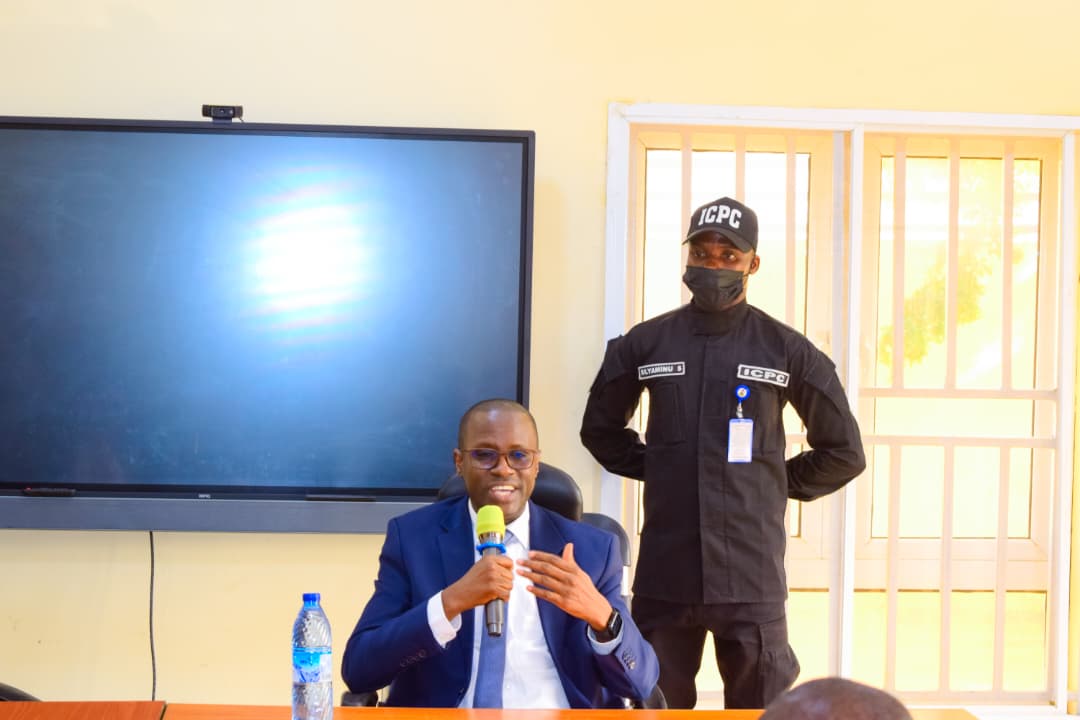
Dr. Aliyu’s first port of call was the ICPC Sokoto State Office, where he was accorded a warm reception by the Resident Anti-Corruption Commissioner (RACC), Mr. Shintema P. Binga, on behalf of the management and staff. The atmosphere was one of palpable enthusiasm as the Chairman addressed the officers, commending their resilience and unwavering dedication in the face of operational challenges that continue to test the Commission’s capacity.
In his address, Dr. Aliyu outlined an ambitious vision for repositioning the ICPC, emphasising that enhanced operational efficiency would be achieved through strategic investments in infrastructure, modernised working tools, and the creation of a more conducive workplace. He disclosed that the Commission is actively pursuing full-scale digital transformation in alignment with the Federal Government’s broader digitisation agenda.
Embracing technology, particularly Artificial Intelligence (AI), featured prominently in the Chairman’s discourse. He noted that leveraging AI would amplify the Commission’s visibility and effectiveness, both domestically and on the international stage, positioning the ICPC as a forward-thinking institution capable of meeting contemporary anti-corruption challenges head-on.
Dr. Aliyu observed with pride the growing recognition of the ICPC across Africa, citing collaborative anti-corruption initiatives that have elevated the Commission’s regional standing. However, he was quick to underscore that the fight against corruption demands collective national effort.
Advocating for a paradigm shift, the Chairman stressed that corruption prevention offers a more sustainable and cost-effective approach than enforcement alone. He called for intensified public enlightenment campaigns targeting children and young people through integrity education and anti-corruption advocacy.
Dr. Aliyu further unveiled the Commission’s ongoing rebranding initiative, describing it as a strategic effort to consolidate past achievements while charting a robust course for the future. “I am committed to leaving this Commission stronger, more resilient, and more effective than I found it,” he pledged.
In his closing remarks, RACC Mr. Shintema P. Binga expressed profound gratitude for the Chairman’s visit, assuring him of the unwavering loyalty and support of the Sokoto State Office staff. “We stand resolute in our commitment to realising the Commission’s mandate,” he affirmed.
The visit featured an interactive question-and-answer session, during which staff engaged the Chairman on various operational matters. This was followed by a tour of office facilities and a commemorative group photograph, capturing a moment of unity and shared purpose.
As part of his engagement in the state, the Chairman featured on a live Hausa-language programme at Vision FM Sokoto, where he elucidated the Commission’s mandate, strategic initiatives, and ongoing reforms designed to promote transparency, accountability, and good governance.
Dr. Aliyu provided an in-depth explanation of the Commission’s Constituency and Executive Projects Tracking Initiative (CEPTI), through which the ICPC monitors the implementation of federally funded constituency and executive projects.
He emphasised that quality infrastructure remains a critical driver of national development and a key factor in attracting both local and foreign investment.
The Chairman further disclosed that the Commission also monitors donor-funded intervention programmes, including the Adolescent Girls Initiative for Learning and Empowerment (AGILE) and other development projects, ensuring they achieve their intended objectives and reach their targeted beneficiaries.
Dr. Aliyu highlighted the establishment of Anti-Corruption and Transparency Units (ACTUs) in Ministries, Departments, and Agencies (MDAs) across the country as a cornerstone of the Commission’s preventive strategy.
He also elaborated on preventive mechanisms such as Systems Study and Review (SSR) and Corruption Risk Assessment (CRA), which help identify and eliminate systemic weaknesses, improve transparency in contract awards and recruitment processes, and reduce opportunities for nepotism and other corrupt practices.
On the technological front, the Chairman noted that the ICPC has embraced digital innovation to enhance transparency and public confidence. He highlighted the Commission’s practice of publishing updates on court proceedings through official social media platforms, enabling citizens to monitor the progress of cases.
Responding to questions on the challenges confronting the Commission, Dr. Aliyu identified the difficulty of tracing proceeds of corruption as one of the major obstacles to effective enforcement.
The Chairman underscored the importance of the Commission’s Students Anti-Corruption Clubs (SACs) in secondary schools, describing the initiative as a strategic investment in the nation’s future.
In his concluding remarks, Dr. Aliyu issued a passionate appeal to all Nigerians to actively support the fight against corruption by reporting corrupt practices to the Commission, providing accurate, credible, and concise information.