

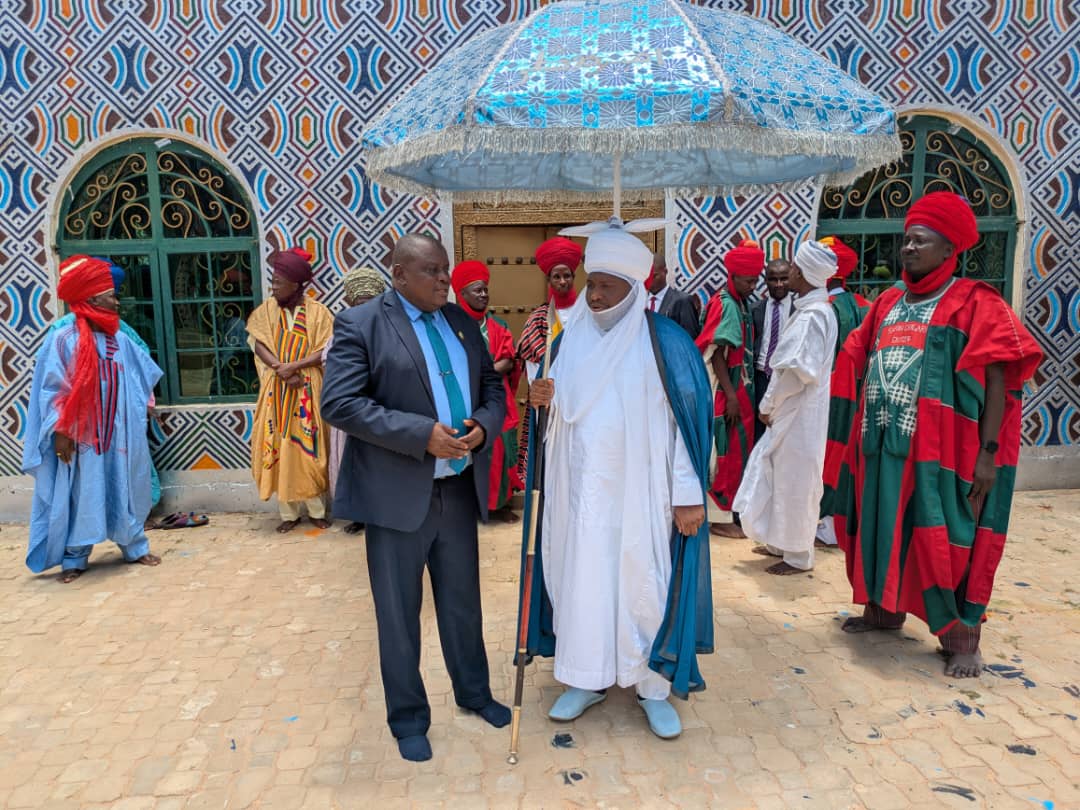
In a significant development underscoring the growing synergy between traditional institutions and the fight against corruption, the Kano and Jigawa State offices of the Independent Corrupt Practices and Other Related Offences Commission (ICPC) have paid a landmark courtesy visit to the Emir of Dutse, Alhaji Hameem Nuhu Muhammad Sanusi CFR.
The high-profile meeting, held recently at the Emir’s palace, signals a renewed commitment to combating corruption through traditional leadership structures in Jigawa State.
His Royal Highness, Alhaji Hameem Nuhu Muhammad Sanusi, delivered insightful remarks during the audience, offering commendation for the Commission’s tireless efforts in upholding probity across the nation.
The Emir, whose influence extends far beyond ceremonial duties, articulated the critical role that traditional institutions must play in the national crusade against corruption, emphasising that the fight cannot be left to statutory agencies alone.
“We must recognise that collective efforts can dramatically transform the lives of our citizens,” the Emir declared, “creating pathways for a brighter future for all equally. The fight against corruption is a struggle that belongs to every Nigerian.”
The Emir particularly applauded the Commission’s whistle-blower policy, though he offered a constructive caveat that deserves earnest consideration. His Royal Highness suggested that for the policy to achieve optimal efficacy, robust protections must be guaranteed for both information and informants’ identities.
“It must not generate fear among citizens, which would inevitably discourage disclosure,” he counseled, highlighting a crucial tension between encouraging whistleblowing and ensuring the safety of those courageous enough to come forward.
Earlier in the proceedings, the Resident Anti-Corruption Commissioner for the two states, Ahmad Muhammad Wada Esq., provided a comprehensive exposition of the Commission’s mandate and operational framework.
In his address, Wada stressed that “integrity is needed in all spheres of society, and appears where there is an absence of standards, personal integrity or professional ethics” – a stark reminder of the moral bankruptcy that corruption engenders when allowed to flourish unchecked.
The Resident Commissioner elaborated that the purpose of the visit was twofold: to strengthen institutional relations between the Commission and traditional institutions, and crucially, to explore opportunities for meaningful collaboration in promoting integrity across both states.
This strategic engagement with traditional leadership represents a paradigm shift in the Commission’s approach to public education and awareness-raising.
Significantly, Wada moved to allay concerns regarding whistle-blower protection, referencing Section 64 of the ICPC Act, which explicitly provides for the safeguarding of information and informants. This legislative provision, he assured the Emir and his council, offers a robust legal framework that should encourage citizens to come forward without trepidation, knowing that the law stands firmly behind them.
The meeting concluded with both parties expressing optimism about future collaboration, with the Emir pledging his unwavering support and that of his traditional council to the Commission’s work in Jigawa State.
The partnership envisages joint public enlightenment campaigns, community engagement programmes, and the establishment of traditional institution-based integrity committees that would serve as early warning systems against corrupt practices.
This strategic alliance between the ICPC and the Dutse Emirate represents a template for engaging traditional institutions in the national anti-corruption architecture.
As Nigeria continues its arduous journey towards transparency and accountability, such partnerships offer hope that the fight against corruption can indeed be waged effectively at every level of society, from the highest echelons of government to the most remote communities where traditional rulers remain the custodians of cultural values and moral rectitude.
The Commission has indicated that similar engagements with other traditional institutions across the federation are being planned, as part of its broader strategy to embed integrity and ethical conduct within the fabric of Nigerian society, one community at a time.