

The Independent Corrupt Practices and Other Related Offences Commission (ICPC) has warned that protecting Nigeria’s critical assets requires more than uniforms, weapons and boots. It said security personnel must not become the very people who expose those assets to danger through bribery, abuse of office, negligence or misuse of authority.
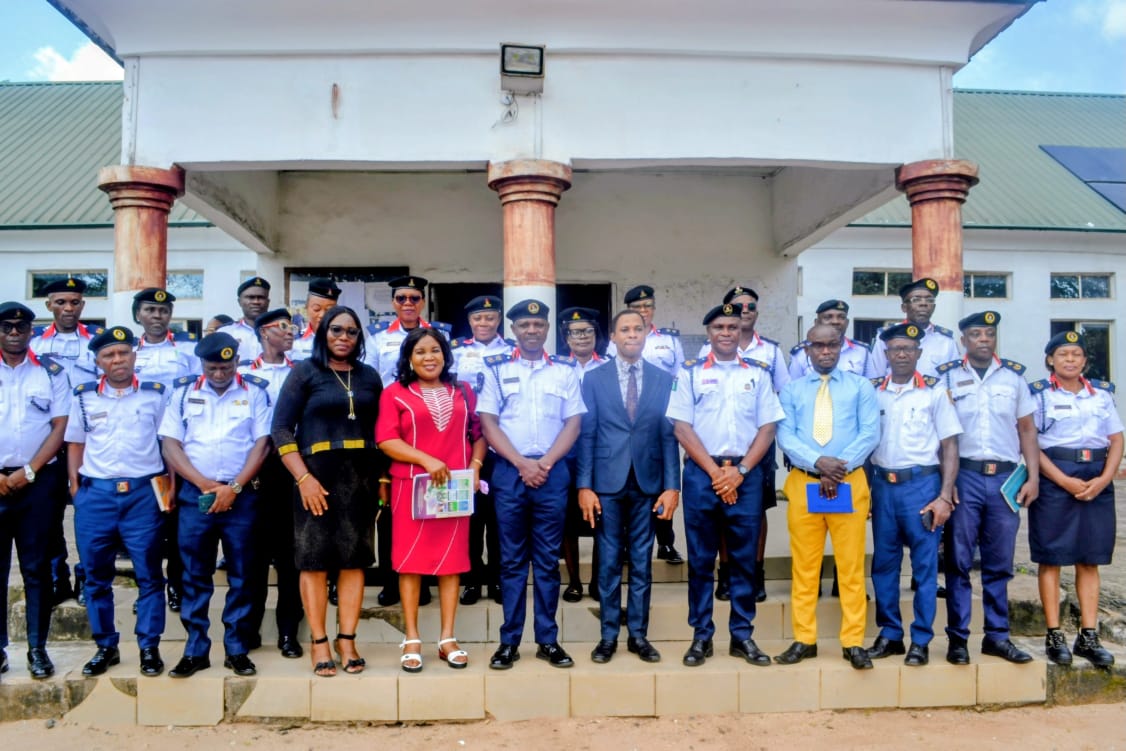
The warning came recently at an anti-corruption sensitisation programme organised by the ICPC for officers and men of the Nigeria Security and Civil Defence Corps (NSCDC), Imo State Command. The programme was aimed at strengthening inter-agency collaboration, deepening knowledge of the Corrupt Practices and Other Related Offences Act 2000 and reinforcing the work of the Anti-Corruption and Transparency Unit (ACTU) in public institutions.
Receiving the delegation, the Imo State Commandant of the NSCDC, Mr Basil Chinaka, described the visit as timely and necessary. He noted that poor knowledge of the law could lead officers into avoidable violations, adding that the sensitisation would help them do the right thing. He reaffirmed the Command’s commitment to working with the ICPC.
In a lecture titled “Confronting Corruption, Abuse of Office and Ethical Failure in the Nigerian Security and Civil Defence Corps”, ICPC Deputy Director Mrs Chinwe Egbeocha described corruption as a major obstacle to Nigeria’s development. She said it manifests in poor infrastructure, declining public revenue, inequality, insecurity, weak education and health outcomes, unemployment, low productivity and persistent poverty. She added that greed, distorted values, poor governance, weak political will, poverty and poor pay help drive corruption, but poor pay cannot justify breaking the law.
Mrs Egbeocha stressed that both personal choices and institutional weaknesses must be addressed, and that every offence must be taken seriously, whether small or large; further outlining the ICPC’s independence under Section 3(14) of the Act and its three mandates: enforcement, prevention, and public education and enlightenment. Its preventive tools include Systems Study and Review, Ethics and Integrity Scorecards, Corruption Risk Assessment, project tracking and ACTU units.
The ICPC Deputy Director identified five major corruption risks for security agencies: bribery and illegal payments; abuse of enforcement powers; recruitment fraud and job racketeering; procurement and contract manipulation; and diversion of government resources and assets. She warned that a corrupt security officer could sell vital information, give access to hostile elements and expose critical national assets to danger.
Mrs Egbeocha urged officers to be role models of integrity and to show zero tolerance for corruption in their daily work. She advised them to ask whether an action is lawful, official, publicly defensible, and something they would recommend to others. She also called on management to reduce opportunities for manipulation, strengthen internal controls, protect whistleblowers, provide regular training and sustain ACTU activities through posters, stickers and other materials.
During an interactive session, participants asked whether reform should start from the top or the bottom and whether sensitisation should target only some Nigerians. Mrs Egbeocha explained the ICPC’s statutory powers, preventive approach and independence from any person or authority.
In her vote of thanks, Superintendent Chidi Edidi, Head of the ACTU at the NSCDC Imo State Command, said the Unit had promoted anti-corruption awareness, provided suggestion boxes and handled corruption-related cases. She urged officers to turn the lessons into action, including during the coming elections, and the engagement ended with a clear message: protecting national infrastructure requires officers whose decisions cannot be bought and whose commitment to Nigeria is stronger than personal gain.