
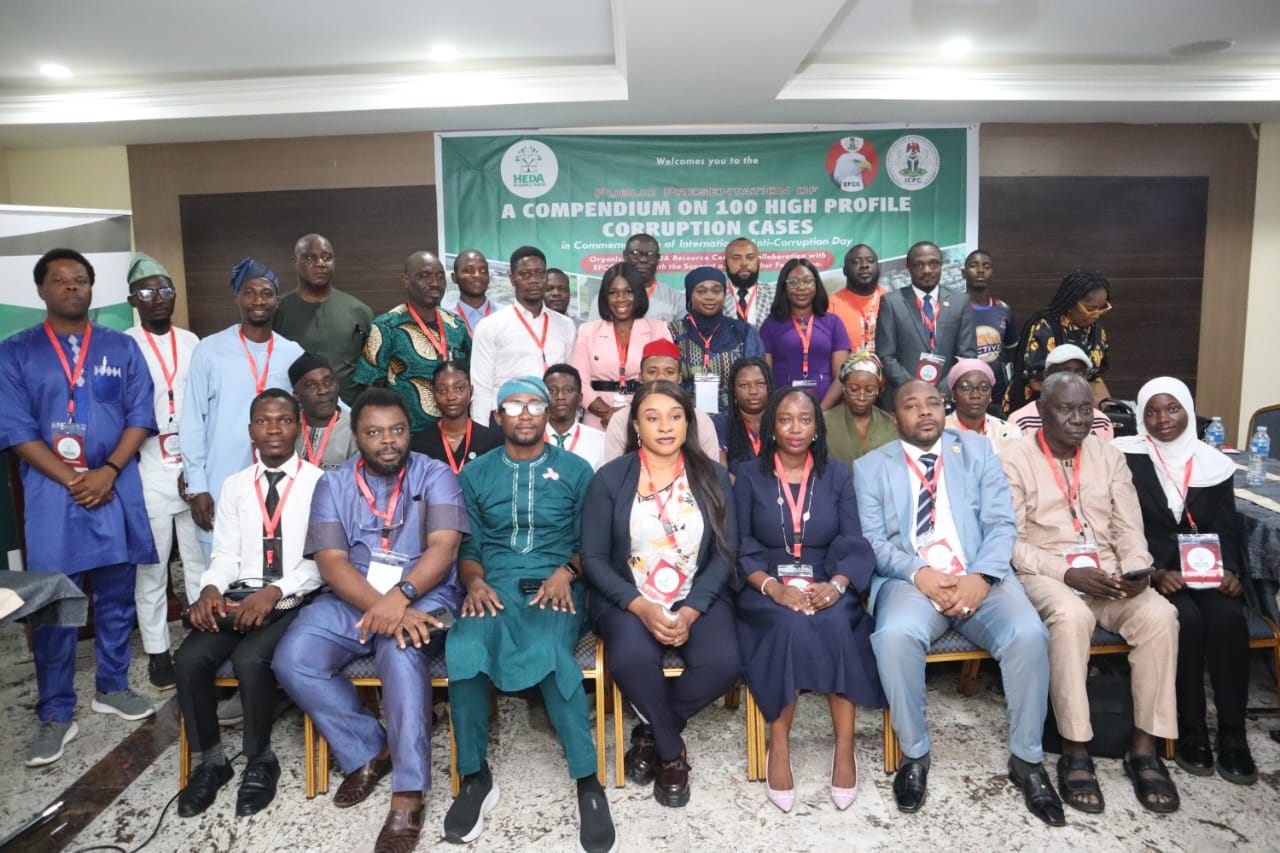
The Independent Corrupt Practices and Other Related Offences Commission (ICPC) has underscored its commitment to engaging young Nigerians as essential partners in tackling corruption during the public presentation of the 9th Compendium on High-Profile Corruption Cases, hosted by the Human & Environmental Development Agenda (HEDA) in Lagos.
Marking World Anti-Corruption Day under the theme “Uniting with Youth Against Corruption: Shaping Tomorrow’s Integrity,” stakeholders gathered in Ikeja to reinforce the national anti-corruption drive. Representing the ICPC Chairman, Mr Alexander Chukuwurah, fsi, delivered a keynote address stressing that the fight against graft must be continuous, inclusive and sustained.
He described the theme as both timely and strategic, noting that no society can rise above the values upheld by its youth, who serve as both tomorrow’s leaders and today’s influencers. Mr Chukuwurah highlighted ICPC’s targeted investment in youth-oriented programmes, including National Youth Service Corps (NYSC) sensitisation sessions, national essay and debate competitions, Anti-Corruption Clubs in schools, and the Students Anti-Corruption Vanguard in universities. These initiatives, he said, are designed to foster integrity, critical thinking and ethical leadership among the younger generation.
Anti-corruption, he emphasised, is not merely a campaign but a culture that must be cultivated through consistent education, engagement and empowerment. The ICPC remains dedicated to strengthening institutions, enhancing preventive measures and building partnerships that amplify youth voices in the national dialogue.
The event was chaired by Mrs Mary Omonoyan, representing the Resident Anti-Corruption Commissioner, reflecting the Commission’s institutional support for civil society-led efforts. Her presence reinforced ICPC’s collaborative approach with non-state actors in advancing transparency and accountability.
In his welcome address, HEDA’s Executive Secretary, Mr Sulaimon Arigbabu, identified corruption as Nigeria’s central challenge, asserting that its effective containment would pave the way for progress in other sectors. He called for stronger systems, deeper partnerships with youth, and sustained advocacy, research and public enlightenment.
Goodwill messages were delivered by representatives of the National Orientation Agency (NOA) and the Lagos State Consumer Protection Agency, both of which aligned with the call for ethical reorientation, civic responsibility, and active youth participation in promoting integrity.
Barrister Muhyi Magaji, immediate past Chairman of the Kano State Public Complaint and Anti-Corruption Commission (PCACC), presented the keynote address titled “Youth as Catalysts of Integrity: Building a Corruption-Free Future for Nigeria.” He urged young people to act with passion and resilience, use social media responsibly, reject divisive narratives, support anti-corruption agencies and engage in collective action.
A further presentation by Mrs Yvonne Williams Mbata of ICPC Lagos, “Youth as Game Changers: Innovative Pathways to Fight Corruption,” highlighted the digital space and social media as powerful tools for transparency and civic engagement when used constructively.
The event featured the launch of the 9th Edition of the Compendium on 100 High-Profile Corruption Cases in Nigeria, reviewed by Mr Adeola Soetan, followed by a panel discussion moderated by Mayowa Shobo. Panellists emphasised the importance of values, ethical living, self-sustainability and legitimate livelihoods, urging youth to consciously reject corruption and contribute positively from their respective spheres as Nigeria works collectively toward a culture of integrity.